writesure
Four things that decide whether your lead picks up
What the market knows about reaching internet leads — speed, the number you call from, why calls drop, and how many attempts it takes. With sources.
A Carrypromise lead verified their phone with a code and saw your name, photo and number before you called. Whether they pick up still depends mostly on four things on the agent's side. None of this is our invention — it's what the published data and working agents agree on. Where a figure comes from a vendor's own numbers rather than independent research, we say so.
A note on dates: the best-measured studies here are from 2007–2019. Newer ones exist, but they are mostly vendor-run or from other industries, and they point the same way. Treat the exact multipliers as orders of magnitude rather than gospel, and judge them against your own numbers.
1. The first minutes decide the first contact
The most-cited study on web leads (MIT / InsideSales, 2007 — academic, 15,000+ leads and 100,000 dials) found the odds of reaching a lead were about 100 times higher at 5 minutes than at 30 minutes, and dropped more than tenfold after the first hour. Most companies don't come close: an audit of 2,241 US firms (Harvard Business Review, 2011) found an average response of 42 hours — 37% replied within an hour, 23% never did. A secret-shop of insurance carriers put the average wait for a call at 2.3 days (Velocify, 2014 — vendor data).
Newer mystery shops in other industries say the same: in 2024, 635 of 1,000 software companies never answered a demo request at all (RevenueHero — vendor-run). Where an industry has been measured on this for years, it looks different: car dealers answered 61% of 1,700 inquiries within 15 minutes (DAS Technology, 2025 — vendor-run).
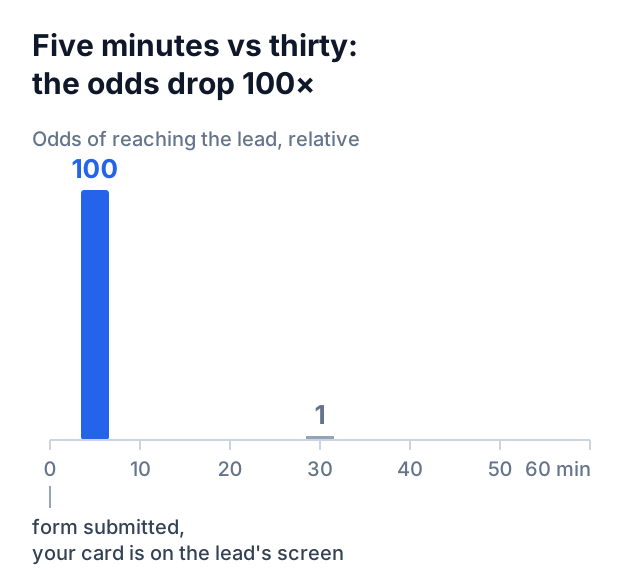
That's the whole reason your Writesure dashboard asks for a text or Telegram alert before you go live. An email alert is a lead you'll read later. (Calling hours are 8 AM–9 PM at the lead's location; after that, a text now and a call in the morning.)
2. The number you call from
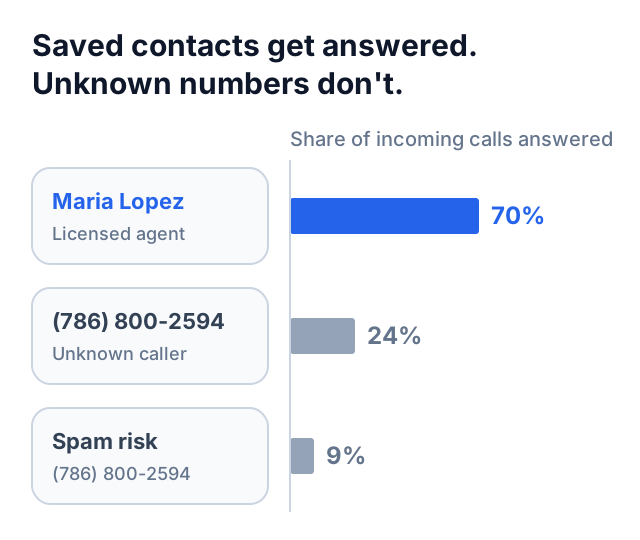
Your lead saw a number on the thank-you page, in their email and in the text they could request — and could save it as a contact. Whether that number is the one that rings matters more than any script. Hiya's analysis of 11 billion calls (2019 — vendor call data) found calls from a saved contact answered 70% of the time, calls from an unidentified number 24%, calls from a spam-flagged number 9%. Its 2026 survey of 12,000 consumers puts it bluntly: 86% won't answer an unidentified call, and 41% let it ring to voicemail first to see whether a message is left. Four in five US adults told Pew Research the same in 2020.
This is also why "local presence" dialers that rotate numbers tend to backfire: rotation is one of the patterns carrier analytics look for, and agents who tested it report every rotated number flagged within days. One number — the Caller ID number on your agent card — for calls and texts.
3. Straight to voicemail or dropped after one ring is usually the number, not the lead
It's rarely the lead rejecting you. It's the carrier or the phone: Verizon sends likely-spam calls to voicemail by default, AT&T's free ActiveArmor app gives a blocked caller one ring, T-Mobile's Scam Block stops the call before the phone rings, Pixel's Call Screen hangs up on its own, and iPhones can silence or screen every number not in Contacts.
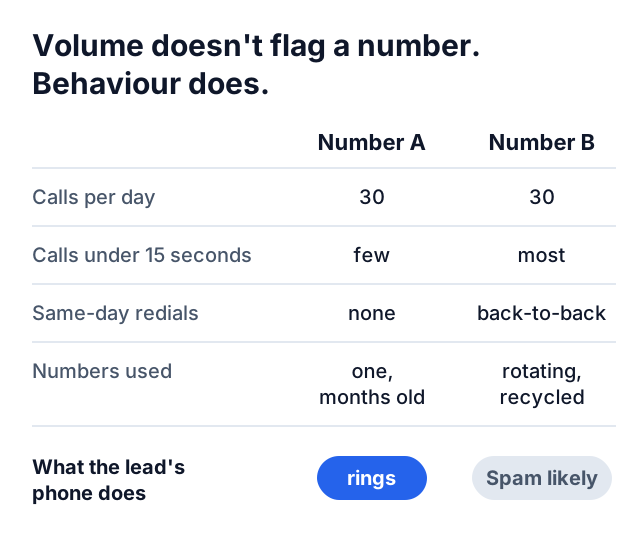
What gets a number flagged is behaviour, not volume: a high share of short or unanswered calls, same-day redials, rotating or recycled numbers, and VoIP lines that aren't properly registered. A solo agent making 30 calls a day is under every published threshold — but 30 unanswered eight-second calls a day looks like a robocaller.
The checks are free and take about 20 minutes: register the number at Free Caller Registry (it reaches the analytics providers behind AT&T, T-Mobile and Verizon), open a free Hiya account to see its reputation grade, register with First Orion, and after 3–5 days call an AT&T, a T-Mobile and a Verizon phone from the number to see what each shows. If a label is wrong, each carrier has a dispute form:
- Free Caller Registry
- Hiya registration and reputation grade
- First Orion registration
- T-Mobile label correction
- TNS / Verizon dispute
- Verizon spam feedback
- AT&T "review my call label"
4. How many attempts it takes
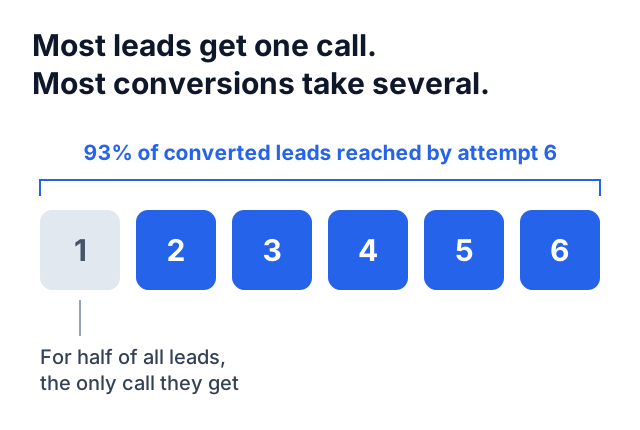
Half of all leads are called only once. In the largest published dataset (Velocify, 2012 — vendor data, ~3.5 million leads), 93% of leads that eventually converted had been reached by the sixth attempt. Working agents on industry forums put normal contact on internet final-expense leads at 25–40%, call 30% a good result, and get there with 6–8 attempts spread over one to two weeks. The one thing everyone agrees on: never more than three attempts in a day, never back-to-back.
What's on our side
Every Carrypromise lead verified their phone, saw your card before the call, and arrives with an instant alert. The four things above are on the agent's side — and all four are cheap to get right.